P Cellid Crashes After-Hours on Phase 3 Failure...Shaperon Dives 25%[K-bio pulse]
created on 06/29/2026 8:00:07 AM
Unauthorized reproduction or distribution is illegal and subject to criminal penalties.
Pharm Edaily enforces a zero-tolerance policy and will take strict action.
Pharm Edaily enforces a zero-tolerance policy and will take strict action.
This article was released as Pharm Edaily Premium Content on 06/29/2026 8:00:07 AM
Subscribe
[Kim Jinsoo, Edaily Reporter] In the biopharmaceutical sector on Friday, Cellid‘s stock surged on expectations for its vaccine clinical trial results, but the shares plunged by the daily limit in after-hours trading following news of a Phase 3 trial failure. A further decline is expected on the next trading day.
Shaperon also saw a significant drop for two consecutive trading days following its own clinical trial failure, though the company hopes for a turnaround by unveiling strategies to continue its trials.
Meanwhile, Rokit Healthcare’s shares rose on news of smooth research and development progress, the completion of its integrated AI medical platform for prediction, prevention, and regeneration, and the imminent Nasdaq listing of its subsidiary.
Cellid Faces Inevitable Drop on Phase 3 COVID-19 Vaccine Trial Results
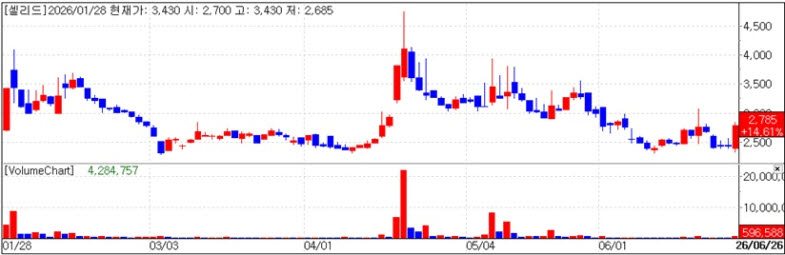
According to KG Zeroin‘s MP DOCTOR (formerly MarketPoint), Cellid shares closed Friday at 2,785 won, up 14.61% from the previous day, driven by anticipation of the Phase 3 clinical trial results for its COVID-19 vaccine candidate, AdCLD-CoV19-1 OMI.
However, after the market closed, Cellid disclosed that it failed to secure meaningful data in the Phase 3 trial, causing its stock to drop 9.87% to 2,510 won in after-hours trading compared to the regular session’s closing price.
Cellid announced Friday that its global Phase 3 trial for the COVID-19 preventive vaccine AdCLD-CoV19-1 OMI failed to demonstrate non-inferiority in the primary immunogenicity endpoint.
The trial was conducted to prove immunogenicity non-inferiority by administering either AdCLD-CoV19-1 OMI or Pfizer‘s COVID-19 vaccine, Comirnaty. The study involved 4,000 adults aged 19 and older.
The primary endpoint was the evaluation of immunogenicity through confirmed neutralizing antibody titers and seroresponse rates. The seroresponse rate (SRR) — the proportion of participants with a fourfold or greater increase in neutralizing antibody titers from baseline — was 17.12% (139 out of 812 participants) in the investigational group and 42.64% (171 out of 401 participants) in the control group. The difference between the two groups was negative 25.51 percentage points. Because this did not exceed the non-inferiority margin of negative 10% set in the trial protocol, the investigational vaccine failed to prove non-inferiority compared to the control group.
In terms of safety, however, no serious adverse drug reactions were reported following the administration of AdCLD-CoV19-1 OMI, satisfying the predicted safety profile.
AdCLD-CoV19-1 OMI drew attention as a purely domestically developed vaccine combining a proprietary adenovirus vector platform and antigen platform technology. Nonetheless, this clinical failure is expected to deal a significant blow.
“Based on the secured safety results, we plan to continue the development of the COVID-19 preventive vaccine and are reviewing additional clinical trial designs and strategies from various angles to supplement the immunogenicity results,” Cellid stated.
Shaperon plunges for 2 consecutive days on trial failure
Shaperon shares plummeted 25.16% from the previous day to close at 568 won on Friday. The stock had also hit the lower daily limit during the previous trading session. The decline is attributed to the failure to meet the primary endpoint in the Phase 2 clinical trial for its atopic dermatitis treatment candidate.
On Wednesday, Shaperon disclosed that it failed to meet the primary endpoint in the global Phase 2b trial of its atopic dermatitis treatment, NuGel.
NuGel is a non-steroidal topical atopic dermatitis treatment developed on Shaperon’s GPCR19-based inflammasome regulation platform. The Phase 2 trial targeted patients with mild to moderate atopic dermatitis, setting the primary endpoint as the degree of improvement in the Eczema Area and Severity Index (EASI) at eight weeks compared to a placebo group.
According to the trial results, the difference in the primary endpoint between the NuGel-administered group and the placebo group did not meet the pre-set statistical significance level (two-sided 0.025).
Consequently, Shaperon plans to conduct further analysis with its contract research organization (CRO) until September and establish future development strategies with regulatory agencies and external experts.
“During the Phase 2b trial, we supplied patients with moisturizers to use freely, which may have diluted the efficacy difference,” a Shaperon representative said. “We are also reviewing the introduction of a quasi-registrational study to examine future approval strategies and the possibility of advancing to Phase 3 trials.”
Rokit Healthcare stock rises on favorable expectations
Rokit Healthcare shares closed at 44,500 won on Friday, up 11.25% from the previous day. The rise is analyzed to reflect expectations for upcoming positive catalysts.
SK Securities analyst Lee Sun-kyung forecasted Friday that Rokit Healthcare will see continued momentum, including clinical trials for kidney regeneration in the second half of the year and a formal contract with U.S.-based Northwell Health. Lee predicted that revenue growth will begin in earnest next year.
Lee noted that Rokit Healthcare recently announced the results of a four-year long-term tracking trial for cartilage regeneration and a three-year long-term tracking trial for skin regeneration conducted in Egypt.
The company also received approval for the world‘s first human clinical study on kidney regeneration, demonstrating its technological prowess and potential for indication expansion. Furthermore, following a mutual non-disclosure agreement (MCA) signed with Northwell Health in February, negotiations are underway aiming for a formal contract in the second half of the year, which is expected to sustain momentum.
However, the burden on profitability due to increased research and development investments is expected to continue this year. “Although it turned a profit last year, it recorded an operating loss of 2.35 billion won in the first quarter of this year due to increased R&D expenses. Considering the multiple ongoing clinical trials, the increase in R&D costs is expected to continue for the time being,” Lee added.
Additionally, it was reported that Rokit Healthcare’s subsidiary, Rokit America, has finalized procedures related to its Form S-1 filed with the U.S. Securities and Exchange Commission (SEC) and entered the final stage for its Nasdaq listing.
Rokit America‘s estimated market capitalization upon listing is approximately 400 billion won. The company is currently conducting book-building for foreign institutional investors and plans to proceed with public offering allocation, price confirmation, and the commencement of stock trading.
“Rokit America’s Nasdaq listing marks the first among subsidiaries of South Korean KOSDAQ-listed biotech companies.”
a Rokit Healthcare representative said “Based on the capital and global credibility secured through the Nasdaq Global Market listing, we aim to preempt the North American market and commercialize our technology in a timely manner, becoming a ‘first mover’ leading the global organ regeneration medical market.”
Shaperon also saw a significant drop for two consecutive trading days following its own clinical trial failure, though the company hopes for a turnaround by unveiling strategies to continue its trials.
Meanwhile, Rokit Healthcare’s shares rose on news of smooth research and development progress, the completion of its integrated AI medical platform for prediction, prevention, and regeneration, and the imminent Nasdaq listing of its subsidiary.
|
According to KG Zeroin‘s MP DOCTOR (formerly MarketPoint), Cellid shares closed Friday at 2,785 won, up 14.61% from the previous day, driven by anticipation of the Phase 3 clinical trial results for its COVID-19 vaccine candidate, AdCLD-CoV19-1 OMI.
However, after the market closed, Cellid disclosed that it failed to secure meaningful data in the Phase 3 trial, causing its stock to drop 9.87% to 2,510 won in after-hours trading compared to the regular session’s closing price.
Cellid announced Friday that its global Phase 3 trial for the COVID-19 preventive vaccine AdCLD-CoV19-1 OMI failed to demonstrate non-inferiority in the primary immunogenicity endpoint.
The trial was conducted to prove immunogenicity non-inferiority by administering either AdCLD-CoV19-1 OMI or Pfizer‘s COVID-19 vaccine, Comirnaty. The study involved 4,000 adults aged 19 and older.
The primary endpoint was the evaluation of immunogenicity through confirmed neutralizing antibody titers and seroresponse rates. The seroresponse rate (SRR) — the proportion of participants with a fourfold or greater increase in neutralizing antibody titers from baseline — was 17.12% (139 out of 812 participants) in the investigational group and 42.64% (171 out of 401 participants) in the control group. The difference between the two groups was negative 25.51 percentage points. Because this did not exceed the non-inferiority margin of negative 10% set in the trial protocol, the investigational vaccine failed to prove non-inferiority compared to the control group.
In terms of safety, however, no serious adverse drug reactions were reported following the administration of AdCLD-CoV19-1 OMI, satisfying the predicted safety profile.
AdCLD-CoV19-1 OMI drew attention as a purely domestically developed vaccine combining a proprietary adenovirus vector platform and antigen platform technology. Nonetheless, this clinical failure is expected to deal a significant blow.
“Based on the secured safety results, we plan to continue the development of the COVID-19 preventive vaccine and are reviewing additional clinical trial designs and strategies from various angles to supplement the immunogenicity results,” Cellid stated.
Shaperon plunges for 2 consecutive days on trial failure
Shaperon shares plummeted 25.16% from the previous day to close at 568 won on Friday. The stock had also hit the lower daily limit during the previous trading session. The decline is attributed to the failure to meet the primary endpoint in the Phase 2 clinical trial for its atopic dermatitis treatment candidate.
On Wednesday, Shaperon disclosed that it failed to meet the primary endpoint in the global Phase 2b trial of its atopic dermatitis treatment, NuGel.
NuGel is a non-steroidal topical atopic dermatitis treatment developed on Shaperon’s GPCR19-based inflammasome regulation platform. The Phase 2 trial targeted patients with mild to moderate atopic dermatitis, setting the primary endpoint as the degree of improvement in the Eczema Area and Severity Index (EASI) at eight weeks compared to a placebo group.
According to the trial results, the difference in the primary endpoint between the NuGel-administered group and the placebo group did not meet the pre-set statistical significance level (two-sided 0.025).
Consequently, Shaperon plans to conduct further analysis with its contract research organization (CRO) until September and establish future development strategies with regulatory agencies and external experts.
“During the Phase 2b trial, we supplied patients with moisturizers to use freely, which may have diluted the efficacy difference,” a Shaperon representative said. “We are also reviewing the introduction of a quasi-registrational study to examine future approval strategies and the possibility of advancing to Phase 3 trials.”
Rokit Healthcare stock rises on favorable expectations
Rokit Healthcare shares closed at 44,500 won on Friday, up 11.25% from the previous day. The rise is analyzed to reflect expectations for upcoming positive catalysts.
SK Securities analyst Lee Sun-kyung forecasted Friday that Rokit Healthcare will see continued momentum, including clinical trials for kidney regeneration in the second half of the year and a formal contract with U.S.-based Northwell Health. Lee predicted that revenue growth will begin in earnest next year.
Lee noted that Rokit Healthcare recently announced the results of a four-year long-term tracking trial for cartilage regeneration and a three-year long-term tracking trial for skin regeneration conducted in Egypt.
The company also received approval for the world‘s first human clinical study on kidney regeneration, demonstrating its technological prowess and potential for indication expansion. Furthermore, following a mutual non-disclosure agreement (MCA) signed with Northwell Health in February, negotiations are underway aiming for a formal contract in the second half of the year, which is expected to sustain momentum.
However, the burden on profitability due to increased research and development investments is expected to continue this year. “Although it turned a profit last year, it recorded an operating loss of 2.35 billion won in the first quarter of this year due to increased R&D expenses. Considering the multiple ongoing clinical trials, the increase in R&D costs is expected to continue for the time being,” Lee added.
Additionally, it was reported that Rokit Healthcare’s subsidiary, Rokit America, has finalized procedures related to its Form S-1 filed with the U.S. Securities and Exchange Commission (SEC) and entered the final stage for its Nasdaq listing.
Rokit America‘s estimated market capitalization upon listing is approximately 400 billion won. The company is currently conducting book-building for foreign institutional investors and plans to proceed with public offering allocation, price confirmation, and the commencement of stock trading.
“Rokit America’s Nasdaq listing marks the first among subsidiaries of South Korean KOSDAQ-listed biotech companies.”
a Rokit Healthcare representative said “Based on the capital and global credibility secured through the Nasdaq Global Market listing, we aim to preempt the North American market and commercialize our technology in a timely manner, becoming a ‘first mover’ leading the global organ regeneration medical market.”
김진수 kim89@


함께보면 좋은 뉴스
![Vaxcell, Biggest Beneficiary of Regenerative Medicine Reform[K-Bio Pulse]](https://image.edaily.co.kr/images/vision/files/NP/S/2026/06/PS26063000325b.jpg)
![[바이오USA]‘한미 빅딜 주역’ 정인기 GID파트너스 대표 “빅파마가 먼저 파킨슨병 세포치료제 찾았다...](https://image.edaily.co.kr/images/vision/files/NP/S/2026/06/PS26063000374b.jpg)
!['바이오USA' 훈풍 속 급등한 로킷·한올·에이프릴…배경은?[바이오 맥짚기]](https://image.edaily.co.kr/images/vision/files/NP/S/2026/06/PS26062500246b.jpg)